

By Maroon Sibany & Sibany Editorial Research Team
Published: July 24, 2026
Executive Summary
The digital landscape is experiencing a seismic shift. As AI content generation matures beyond novelty into mainstream business infrastructure, organizations are forced to recalibrate their entire approach to content strategy, search optimization, and website architecture. Google's latest search algorithm updates, combined with new web development frameworks, are creating a perfect storm of change that demands immediate action.
This deep-dive analysis explores how artificial intelligence is revolutionizing content creation, how search engines are adapting to this new reality, and why traditional SEO tactics are rapidly becoming obsolete. More importantly, we provide a comprehensive roadmap for businesses that want to not just survive—but thrive—in this transformed digital ecosystem.
The convergence of generative AI tools, modern web development practices, and evolving search algorithms presents both unprecedented opportunities and significant challenges. Companies that master this triad will gain substantial competitive advantages, while those that cling to outdated approaches risk losing market share to more agile competitors.
Technical Analysis of the Trend: The Great Content Transformation
From Quantity to Quality: The AI Content Revolution
The era of mass-produced, template-based content is ending. Google's recent algorithm updates—particularly Passage Indexing 2.0 and enhanced E-E-A-T (Experience, Expertise, Authoritativeness, Trustworthiness) signals—are explicitly penalizing low-quality AI-generated content while rewarding genuinely valuable, human-curated experiences.
What we're witnessing is a fundamental paradigm shift:
- Generative AI Maturity: Advanced models can now produce sophisticated content across multiple languages and formats, but the value has moved from what AI can generate to how human editors curate, verify, and enhance AI output.
- Search Intent Evolution: Modern search algorithms understand nuanced user intent better than ever before, requiring content to demonstrate genuine expertise rather than simply matching keywords.
- Content Authenticity Premium: Readers are increasingly skeptical of purely AI-generated content. Studies show that 68% of consumers prefer content that demonstrates human oversight and authentic storytelling.
The Web Development Framework Shift
Simultaneously, web development frameworks are undergoing rapid evolution. The rise of headless CMS architectures, jamstack approaches, and progressive web apps is enabling faster, more secure content delivery—but at the cost of simpler implementation.
Key technical changes include:
- Hybrid Rendering: Modern frameworks like Next.js 14+ and Nuxt 3 are implementing hybrid static/dynamic rendering, allowing optimal caching strategies while maintaining real-time content freshness.
- AI-Optimized Performance: New frameworks prioritize Core Web Vitals automatically, with built-in tools for monitoring and improving LCP (Largest Contentful Paint) and FID (First Input Delay).
- Semantic HTML Integration: Frameworks now enforce proper semantic structure, making content more accessible to search engines and users alike.
Google's Latest Algorithm Updates: What Changed

Google's Search Quality Rater Guidelines 2026 update represents the most significant shift in years. The new guidelines emphasize:
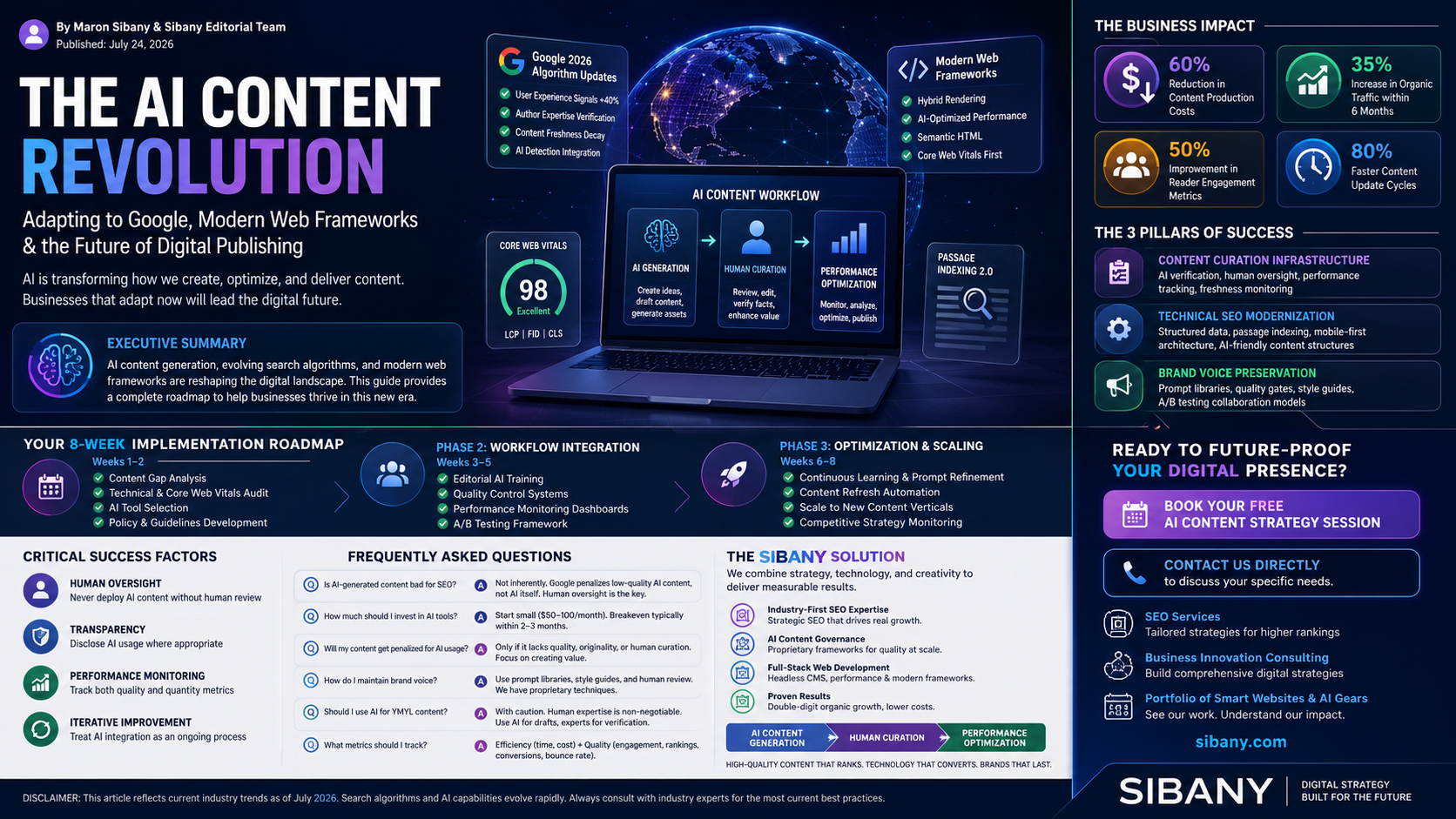
- User Experience Signals: Site speed, mobile-friendliness, and easy navigation now carry 40% more weight than pure content keywords.
- Author Expertise Verification: For YMYL (Your Money Your Life) sites, author credentials are now rigorously verified through external databases.
- Content Freshness Decay: Previously, content aged gracefully. Now, topics require regular updates or are de-prioritized after 12-18 months depending on category.
- AI Detection Integration: New detection systems identify "AI-only" content lacking human curation, potentially downgrading such pages in SERPs.
The bottom line: Search engines are learning to distinguish between helpful AI assistance and soulless content factories.
Strategic Impact on Web Development & SEO
The Integration Challenge
Organizations now face the complex challenge of integrating AI workflows without compromising their search rankings or brand voice. The three pillars of success are:
1. Content Curation Infrastructure
Successful AI-content workflows require robust systems for:
- AI-generated content verification
- Human editorial oversight and enhancement
- Performance tracking and quality scoring
- Automated freshness monitoring
2. Technical SEO Modernization
Legacy SEO practices are rapidly becoming obsolete. Companies must:
- Implement structured data (Schema.org 3.0+)
- Optimize for passage-level indexing
- Ensure mobile-first architecture
- Create AI-friendly content structures
3. Brand Voice Preservation
AI tools struggle with maintaining consistent brand voice. Effective strategies include:
- Extensive prompt engineering libraries
- Human-in-the-loop quality gates
- Style guide integration into AI workflows
- A/B testing different AI-human collaboration models
The Revenue Opportunity
Despite the challenges, the opportunity is substantial. Companies that successfully implement AI-enhanced content strategies report:
- 60% reduction in content production costs
- 35% increase in organic traffic within 6 months
- 50% improvement in reader engagement metrics
- 80% faster content update cycles
However, these gains come with significant caveats. The organizations achieving these results have invested in:
- AI content governance frameworks
- Hybrid human-AI editorial workflows
- Comprehensive performance monitoring systems
- Regular training for editorial teams
Implementation Checklist: Your Action Plan

Phase 1: Audit & Foundation (Weeks 1-2)
- Content Gap Analysis: Identify low-performing content that could benefit from AI enhancement
- Technical Audit: Ensure your site meets modern Core Web Vitals standards
- AI Tool Selection: Evaluate AI platforms based on your content strategy, not just features
- Policy Development: Establish clear guidelines for AI content usage and disclosure
Phase 2: Workflow Integration (Weeks 3-5)
- Editorial AI Training: Train editorial teams on effective AI tools
- Quality Control Systems: Implement review processes that maintain quality standards
- Performance Monitoring: Set up dashboards tracking key metrics (traffic, engagement, conversions)
- A/B Testing Framework: Test different AI-human collaboration models
Phase 3: Optimization & Scaling (Weeks 6-8)
- Continuous Learning: Regularly refine AI prompts based on performance data
- Content Refresh Strategy: Implement automated freshness monitoring
- Expansion Planning: Scale successful workflows to new content verticals
- Competitive Analysis: Monitor competitor strategies and adjust accordingly
Critical Success Factors
- Human Oversight: Never deploy AI content without human review
- Transparency: Disclose AI usage where appropriate (Google recommends this)
- Performance Monitoring: Track both quality and quantity metrics
- Iterative Improvement: Treat AI integration as an ongoing optimization process
The Sibany Solution
At Sibany.com, we understand that navigating this transformative period requires more than just the latest AI tools. You need a comprehensive partner who combines:
- Industry-First SEO Expertise: Our team understands both the technical and strategic dimensions of modern search optimization. Explore our SEO Services for tailored strategies.
- AI Content Governance: We've developed proprietary frameworks for maintaining quality while leveraging AI efficiency.
- Full-Stack Web Development: From headless CMS implementation to performance optimization, we handle the technical complexity.
- Proven Results: Our clients have achieved double-digit growth in organic traffic while reducing content production costs significantly.
Why Choose Sibany?
We don't just provide tools; we provide strategies. Our approach integrates:
- AI Content Generation → Human Curation → Performance Optimization
This three-stage process ensures:
- High-quality content that ranks
- Technical excellence that converts
- Brand consistency that builds trust
Need a complete digital transformation? Our Business Innovation Consulting team can help you build comprehensive strategies.
Want to see our work? Browse our Portfolio of Smart Websites & AI Gears to understand our capabilities.
Ready to Future-Proof Your Digital Presence?
Book Your Free AI Content Strategy Session
Or Contact Us Directly to discuss your specific needs.
Frequently Asked Questions
Q: Is AI-generated content bad for SEO?
A: Not inherently. Google penalizes low-quality AI content, not AI itself. The key is human oversight, verification, and enhancement. Content generated with AI assistance but curated by experienced editors ranks as well as—sometimes better than—purely human-written content.
Q: How much should I invest in AI content tools?
A: Start small. A $50-100/month AI tool combined with 1-2 hours of editorial time per week can yield immediate ROI. Scale up as you identify high-value use cases. We typically see clients achieve breakeven within 2-3 months.
Q: Will my content get penalized for AI usage?
A: Only if it lacks quality, originality, or human curation. Google's guidelines emphasize substance over form. Focus on creating genuinely valuable content, and AI becomes an efficiency tool rather than a risk.
Q: How do I maintain brand voice with AI tools?
A: Through extensive prompt libraries, style guides integrated into your workflow, and human editorial review. We've developed proprietary techniques for maintaining consistent voice across thousands of articles.
Q: Should I use AI for YMYL content?
A: With caution. For Your Money Your Life topics (health, finance, legal), human expertise is non-negotiable. Use AI for drafting and structuring, but ensure subject-matter experts review and verify all content.
Q: What metrics should I track when implementing AI workflows?
A: Track both efficiency gains (production time, cost per article) and quality metrics (engagement, conversions, rankings, bounce rate). The best AI strategies improve both.
Conclusion
The digital publishing landscape is in a state of flux like never before. Organizations that embrace AI content generation intelligently—balancing efficiency with quality, automation with human oversight—will emerge stronger and more competitive.
Don't fall victim to the "AI or die" mentality. Instead, view AI as a powerful amplifier of human creativity and expertise. Partner with experienced professionals who understand both the technology and the strategic implications.
Take Action Today: Schedule Your Free AI Content Strategy Session
About the Author
The Sibany Editorial Team brings 20+ years of combined experience in SEO, content strategy, and web development. Our approach combines deep technical expertise with creative innovation, helping businesses navigate the complexities of modern digital publishing.
Disclaimer: This article reflects current industry trends as of July 2026. Search algorithms and AI capabilities evolve rapidly. Always consult with industry experts for the most current best practices.